Cayo District, Belize
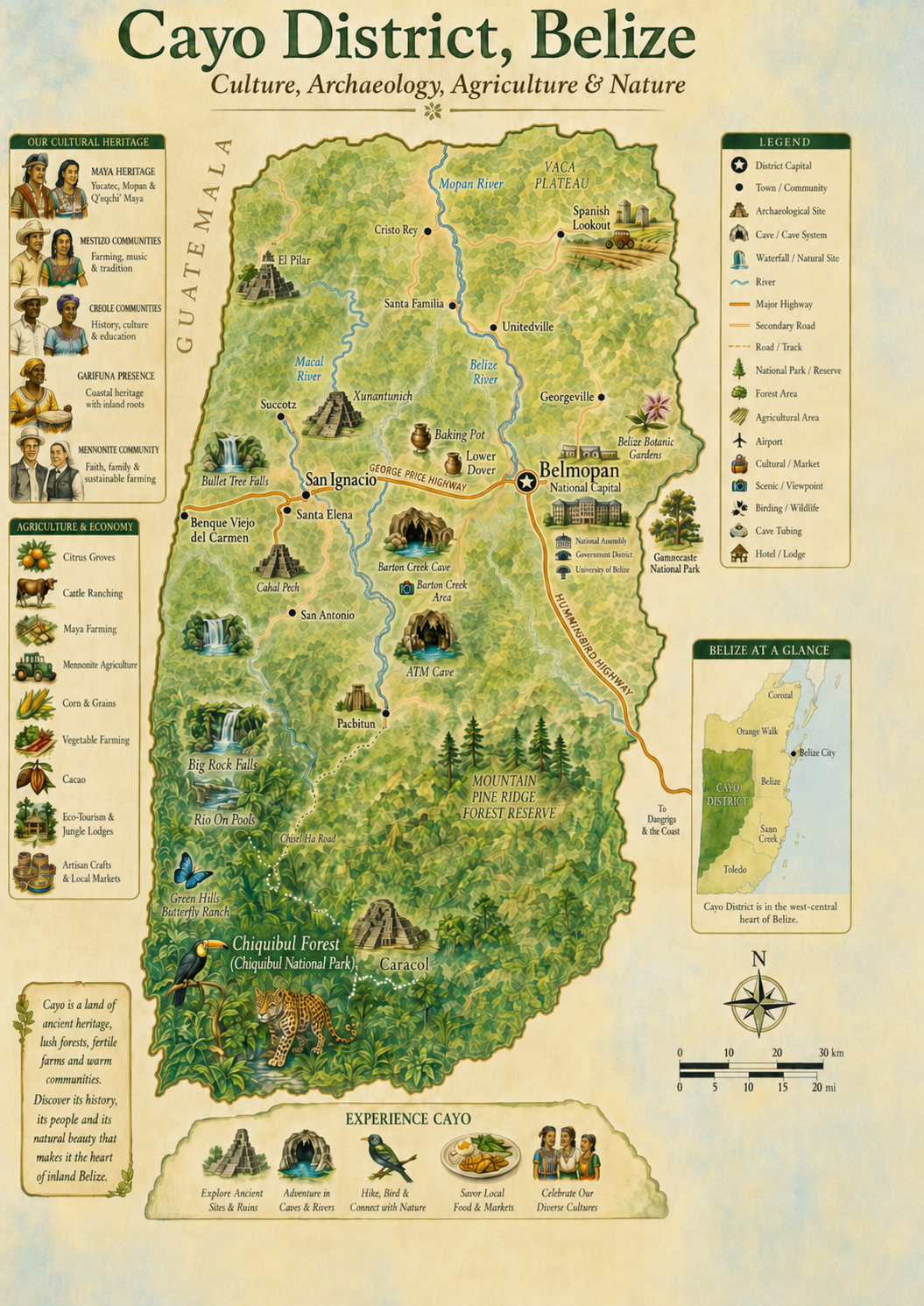
Cayo is the largest district in Belize, covering 5,338 km² in the western part of the country along the border with Guatemala. Its 2024 population estimate is 103,413, making it one of Belize’s major population centers outside the coast. The district includes San Ignacio and Santa Elena, Belmopan, Benque Viejo del Carmen, Spanish Lookout, San Antonio, San José Succotz, and many rural villages and farming communities.
Cayo is often described as the inland heart of Belize. Unlike the cayes and coastal districts, Cayo is known for rivers, rainforest, caves, waterfalls, farms, archaeological sites, and protected natural areas. The Macal and Mopan Rivers shape much of the district’s settlement, tourism, and agricultural life, while the Mountain Pine Ridge, Chiquibul region, and other reserves make Cayo one of Belize’s most important areas for eco-tourism and outdoor adventure.
Long before modern Belize existed, Cayo was part of the ancient Maya world. The district’s limestone hills, river valleys, caves, and forests supported major Maya cities, ceremonial centers, trade routes, agricultural systems, and sacred landscapes. Today, visitors can explore some of Belize’s most important Maya sites here, including Xunantunich, Caracol, Cahal Pech, El Pilar, Barton Creek Cave, and Actun Tunichil Muknal, commonly called ATM Cave.
Xunantunich, near San José Succotz, is one of Belize’s most dramatic and accessible Maya sites. Its great temple, El Castillo, rises about 39 meters above the plaza and offers views across the Mopan River valley toward Guatemala. Caracol, located deep in the Chiquibul Forest Reserve, is one of the largest Maya sites in Belize, covering nearly 25,000 acres and showing evidence of advanced city planning and extensive agricultural systems.
Cayo’s caves also hold deep cultural and spiritual significance. To the ancient Maya, caves were not only natural formations but sacred places connected with water, fertility, ritual, and the underworld. Actun Tunichil Muknal is especially important because it preserves ceremonial artifacts and human remains in a cave environment, making it one of the most powerful archaeological experiences in Belize.
Cayo is also a district of living cultures, not only ancient history. Its communities include Mestizo, Creole, Maya, Mennonite, Garifuna, East Indian, Chinese, and other Belizean families. English is the official language of Belize, but Spanish, Belizean Kriol, Maya languages, and Plautdietsch/German-speaking Mennonite traditions are also part of the district’s everyday cultural landscape.
Agriculture remains central to Cayo’s identity. The district’s fertile valleys, open lands, and farming communities support cattle, dairy, citrus, corn, beans, vegetables, and other crops including Oxmul's Coffee farm. Spanish Lookout and other Mennonite farming communities are especially known for their role in Belize’s dairy, poultry, grain, and agricultural production.
Together, these layers make Cayo one of Belize’s richest and most diverse regions. It is a place where ancient Maya cities, sacred caves, rainforest reserves, rivers, farms, village life, and modern multicultural Belize all meet. For visitors, Cayo offers a deeper view of Belize beyond the beach: a landscape of history, culture, agriculture, archaeology, and natural beauty.
Sources
- Statistical Institute of Belize, Abstract of Statistics 2023, population estimates for 2022–2024.
- Travel Belize, Western Belize overview.
- Travel Belize, Caracol.
- Travel Belize, Belize Archaeology Symposium / Cayo archaeology references.
- Travel Belize, San Ignacio / ATM Cave.
- Hamanasi, Cultures of Belize overview.
- Government of Belize Press Office, agriculture and dairy industry reference.
Discover Belize: History, Culture, and Nature